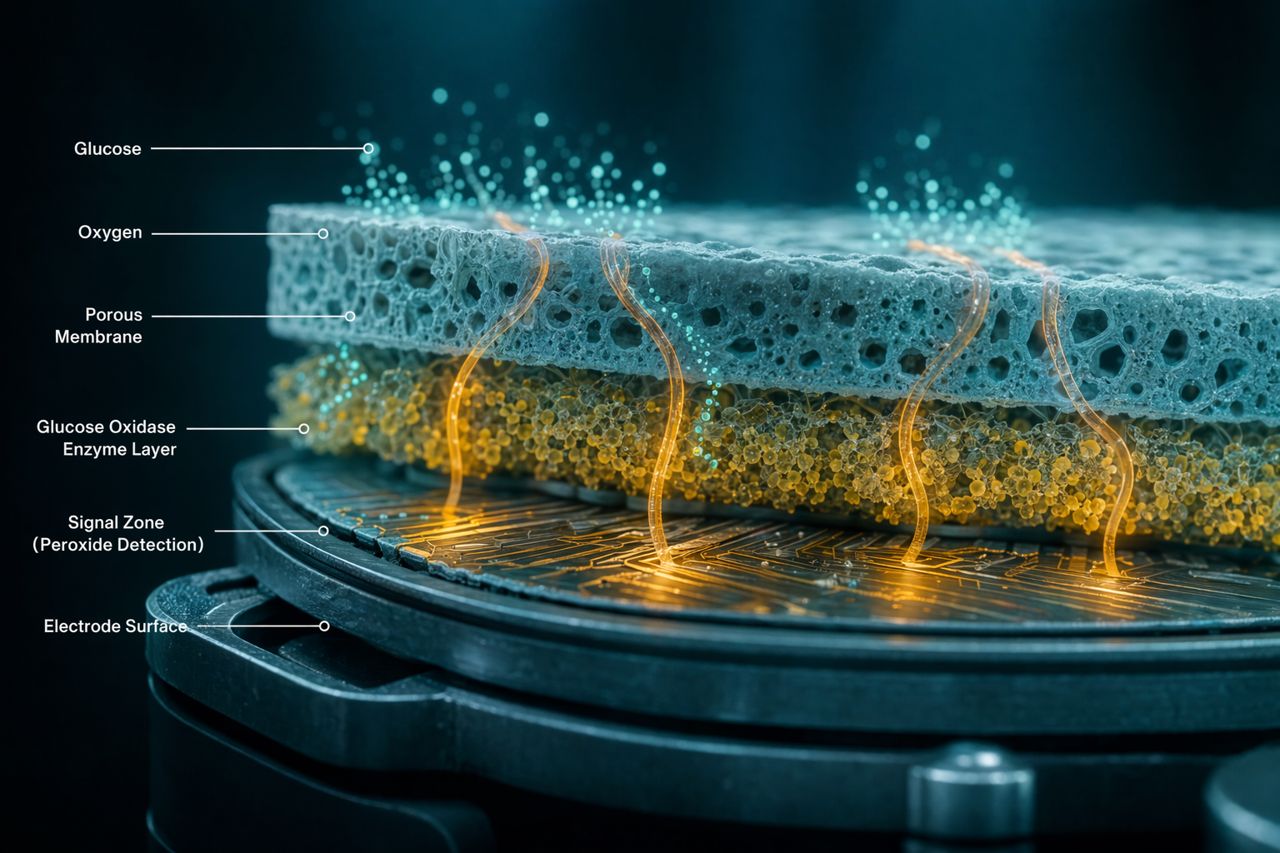
See the reaction at work
Glucose Oxidase in Biosensor and Technical Applications
Glucose Oxidase is used where a system needs a controlled biochemical response to glucose and oxygen. In technical formulations, the enzyme converts beta-D-glucose and dissolved oxygen into gluconic acid and hydrogen peroxide. That reaction can be measured, coupled, contained, or used to modify the local oxygen environment.
For biosensor developers, packaging engineers, diagnostic component suppliers, and specialty formulation teams, the value is not the reaction alone. It is the enzyme's predictable behavior when immobilized, dried, coated, laminated, blended, or integrated into a device architecture.
Glucose Oxidase Solutions supplies glucose oxidase in bulk for B2B technical use: biosensor and test-strip developers, diagnostic-component and reagent manufacturers, packaging and coating producers, and the laboratory-supply distributors who resell to them. Material consistency, documentation and application fit matter as much as price, and every order is quoted individually.
Wholesale and bulk supply for manufacturers, distributors and resellers. Every glucose oxidase order is quoted individually. Request a quote with the grade or application, the quantity you need and the destination country.
Why Glucose Oxidase is used in biosensors
Glucose Oxidase remains one of the most widely used enzymes in glucose-responsive systems because it links a specific substrate to measurable chemical change.
Common detection strategies include:
- Oxygen depletion tracking where glucose concentration is inferred from oxygen consumption.
- Hydrogen peroxide detection where peroxide generated by the reaction is measured electrochemically or optically.
- Mediator-assisted electron transfer in systems designed to move charge efficiently between enzyme layer and electrode.
- Colorimetric or chemiluminescent coupling where peroxide drives a secondary signal reaction.
- Glucose-triggered material response in gels, films, membranes, and smart coatings.
The enzyme is useful because it can sit at the center of a controlled cascade: glucose enters, oxygen participates, and the output becomes measurable or functional.
Technical roles beyond conventional glucose sensing
Glucose Oxidase is also used in industrial and engineered systems that require controlled oxygen removal, peroxide formation, or localized pH shift.
Oxygen scavenging systems
In sealed or semi-sealed systems, Glucose Oxidase can help reduce residual oxygen when glucose and suitable moisture conditions are available. This makes it relevant to technical packaging concepts, oxygen-sensitive formulations, and controlled-atmosphere applications.
Peroxide generation in situ
Some systems use Glucose Oxidase to generate low, localized hydrogen peroxide rather than adding peroxide directly. This can improve handling simplicity and timing in multi-component formulations, provided downstream compatibility is engineered carefully.
Immobilized enzyme coatings
Glucose Oxidase may be immobilized into polymer matrices, membrane layers, beads, fibers, hydrogels, or electrode-adjacent films. The immobilization strategy affects response time, diffusion limits, stability, and reusability.
Analytical and process-monitoring components
The enzyme can be used in technical devices for sugar monitoring, fermentation tracking, laboratory cartridges, flow cells, and inline analytical concepts where glucose presence or depletion is process-relevant.
Formulation and device-design considerations
Successful use of Glucose Oxidase depends on the full system, not only on the enzyme grade. Procurement and R&D teams should evaluate the following early.
Oxygen availability
The reaction requires oxygen. If oxygen is limited, the system may become mass-transfer controlled. In sensor formats, this can influence signal linearity. In scavenging formats, it defines how quickly residual oxygen can be consumed.
Glucose access
Glucose must reach the enzyme layer. Membrane selection, coating thickness, matrix porosity, and water activity can all change response speed and signal strength.
Hydrogen peroxide management
Hydrogen peroxide may be the desired output, a measured intermediate, or an unwanted stressor. Device architecture should account for peroxide compatibility with electrodes, dyes, binders, adhesives, packaging layers, and nearby enzymes.
pH drift
The formation of gluconic acid can shift local pH. In miniaturized or low-buffer systems, this can affect enzyme performance, signal chemistry, and material compatibility.
Immobilization chemistry
Physical entrapment, adsorption, covalent attachment, crosslinked films, and membrane confinement can each work, but they produce different tradeoffs in leaching resistance, activity retention, shelf stability, and manufacturing repeatability.
Dry-format stability
If the enzyme is used in strips, films, pads, laminates, or dry reagent zones, humidity control, excipient selection, and packaging barrier properties become critical.
Application fit by technical segment
| Segment | Typical enzyme function | Key buyer concern |
|---|---|---|
| Electrochemical biosensors | Converts glucose into a measurable electrochemical response | Lot consistency, immobilization behavior, low background interference |
| Optical glucose systems | Supports peroxide-linked color or light output | Signal clarity, reagent compatibility, shelf stability |
| Oxygen scavenging films and inserts | Consumes oxygen in the presence of glucose | Moisture window, reaction speed, packaging compatibility |
| Smart coatings and hydrogels | Creates glucose-responsive local chemistry | Diffusion control, matrix compatibility, repeatability |
| Fermentation and process analytics | Enables glucose monitoring in liquid systems | Robustness, response profile, documentation |
| Research and prototype devices | Provides a proven glucose-responsive catalyst | Development quantity, technical support, scale-up path |
Procurement specification points
When sourcing Glucose Oxidase for biosensor or technical use, the commercial conversation should be framed around the application, not only the catalog name.
Useful specification inputs include:
- Target application: sensor, scavenger, coating, analytical reagent, or technical formulation.
- Required format: powder, granulated material, stabilized preparation, or custom blend feasibility.
- Expected use environment: aqueous, dry film, polymer matrix, membrane, electrode surface, or packaged insert.
- Documentation requirements: specification sheet, certificate of analysis, SDS, regulatory statements, origin information, and change-control expectations.
- Packaging needs: sample size, pilot quantity, production batch size, moisture protection, and reseal requirements.
- Stability expectations: storage condition, shipping route, handling environment, and desired shelf-life profile.
Glucose Oxidase Solutions can align the Glucose Oxidase grade and documentation package to the intended technical application before purchasing decisions are locked.
Quality and supply considerations
Technical enzyme buyers usually need more than a one-time sample. They need continuity from feasibility work to scale-up.
Glucose Oxidase Solutions supports sourcing discussions around:
- Bulk and development quantities.
- Lot-to-lot supply planning.
- Application-oriented documentation.
- Packaging formats suitable for industrial handling.
- Confidential review of formulation constraints.
- Scale-up planning from prototype to production.
No public assay recipe or trader-confidential activity method is required to start the conversation. For commercial evaluation, Glucose Oxidase Solutions focuses on application fit, material documentation, and agreed quality attributes.
Integration notes for formulation teams
For early screening, compare candidate enzyme lots in the same matrix, membrane, binder, buffer, or coating stack planned for production. A material that performs well in open solution may behave differently once dried, laminated, crosslinked, or diffusion-limited.
Recommended development sequence:
- Define the signal or function required from the enzyme reaction.
- Map oxygen, glucose, water, and peroxide pathways.
- Select the immobilization or containment strategy.
- Check compatibility with binders, electrodes, dyes, membranes, preservatives, and packaging layers.
- Run accelerated and real-time stability checks under the intended storage format.
- Confirm purchasing documentation and batch continuity before validation.
Request pricing for Glucose Oxidase
If you are evaluating Glucose Oxidase for biosensor, oxygen scavenging, analytical, coating, or other technical applications, send the application context, the quantity range and the destination country through the inquiry form at the foot of this page. Glucose Oxidase Solutions responds with grade guidance, availability, documentation options and a quote per order.
Frequently asked questions
Is Glucose Oxidase suitable for immobilized biosensor layers?
Yes. It is commonly used in immobilized enzyme systems, including membranes, coatings, hydrogel structures, and electrode-adjacent reagent layers. The best approach depends on diffusion path, intended signal chemistry, and stability target.
Can Glucose Oxidase be used for oxygen scavenging?
Yes, when the full system provides glucose, suitable moisture, and a compatible environment. Oxygen scavenging performance is controlled by formulation design, packaging geometry, and mass transfer.
Does Glucose Oxidase always require a co-enzyme or mediator?
Not always. Some systems measure oxygen consumption or hydrogen peroxide generation directly. Other systems use mediators or coupled reactions to improve signal handling or optical output.
What information is needed to get pricing?
Provide the application, required format, approximate quantity, destination country, documentation needs, and whether the material is for screening, pilot work, or recurring production.
Can Glucose Oxidase Solutions support confidential technical discussions?
Yes. For B2B projects, Glucose Oxidase Solutions can review application requirements confidentially and recommend a practical sourcing path for Glucose Oxidase.